
This would be India's largest crowd-funded programme to help patients with a particular disease.
As many as 34 new drugs were added to and 26 dropped from an updated list of essential medicines on Tuesday, with the government saying this will reduce "patients' out-of-pocket expenditure". The National List of Essential Medicines (NLEM 2022) has 384 drugs, up from 376 in 2015. "Drafting this list is a lengthy process, and around 350 experts from across India have held over 140 consultation meetings to draft the NLEM 2022," Union Health Minister Mansukh Mandaviya said.

The small-cap universe outperformed large-caps, but failed to match the returns generated by mid-caps in August. The Nifty Smallcap 100 Index rose 4.9 per cent. By comparison, the Nifty50 Index rose 3.5 per cent and the Nifty Midcap 100 soared 6.2 per cent. This was only the third calendar month in 2022 when the small-cap index has outperformed the large-cap-oriented Nifty50 Index.

'Just put a patch on your arm and the vaccine can be absorbed by the body.'

In August, domestic equity markets garnered one of the highest foreign portfolio investor (FPI) flows since the outbreak of the pandemic in 2020, despite the US Federal Reserve standing firm on unwinding its stimulus measures to control inflation. FPIs pumped in over Rs 51,000 crore ($6.4 billion) in August, the most since December 2020 and the third-highest tally since March 2020-the month the Covid-19 pandemic roiled global markets. This was the second consecutive month of positive foreign flows. In the preceding nine months, FPIs had yanked out over $32 billion or Rs 2.2 trillion.
A sharp rally in domestic stocks from June lows has once again rendered Indian markets expensive to their emerging-market (EM) peers. The 12-month forward price-to-earnings (P/E) multiple for the Nifty50 Index is around 20.6x - 82 per cent higher than 11.3 per cent for the MSCI EM Index. India's valuation premium has hit a five-month high. This is on the back of sharp outperformance to EM and global peers from June lows and also due to earnings downgrades, following the April-June quarter of 2022-23 earnings.
'Gift-giving' - from free dinners and drug samples to promotional merchandise - seems to be driving drugmakers' marketing - a marketing prescription deeply entrenched in the industry. This is a well-oiled racket that sees pharmaceutical (pharma) companies 'gifting' doctors to push their respective drugs under the guise of marketing. But is there a cure in sight to end this unhealthy alliance? The recent controversy following the income-tax raids on Bengaluru-based drugmaker Micro Labs, makers of popular paracetamol brand Dolo-650, has brought this to the fore, again.

The benchmark Sensex is 2.4 per cent shy of a new lifetime high but the market capitalisation (m-cap) of all companies listed on the BSE is already in the record books. At Thursday's (August 18) closing price, the total m-cap of 4,776 firms on the BSE stood at Rs 280.5 trillion, surpassing the previous high of Rs 280 trillion on January 17. This, even if the Nifty Midcap 100 is currently 5.4 per cent below its lifetime high, while the Nifty Smallcap 100 index is down over 20 per cent.

'The tie-up with Serum Institute Life Sciences brings to the table their strengths in manufacturing and also their vaccine portfolio.'
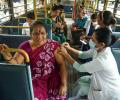
'We are trying to salvage 50-100 million doses of Covishield with the latest drive on booster doses.'
Bulk of the medicine sales in the $22-24 billion domestic pharma market happens through offline retail chemists. With the entry of online pharmacies, this space has started to witness a shake-up. Sample this: Dawaa Dost, a Rajasthan based digital health start-up, generates medicine orders from 'kirana' stores and women self-help groups (SHGs) that operate in villages, and then service these orders through its affiliated network of pharmacies. Biddano, another health-tech start-up, has a platform that acts as an aggregator for neighbourhood chemist shops.

Trading volumes for the equities cash segment remained soft, even as the benchmark indices rallied nearly 9 per cent in July. Meanwhile, volumes in the futures and options (F&O) market dipped marginally, but continued to hover at record levels. In July, the average daily turnover (ADTV) for the cash segment was Rs 46,602 crore, up 4.5 per cent month-on-month (MoM), but 26 per cent lower than the preceding 12-month average.

A new generation of investors has taken to stock trading on mobile phones with a renewed zeal, driven mainly by social changes after the Covid-19 pandemic breakout. The proportion of the cash market turnover ascribed to mobile phones has jumped from 5.3 per cent in June 2019 to 18.7 per cent in June this year, reveals BSE data. The share of mobile trading on the National Stock Exchange (NSE) for June this year stood at 19.5 per cent.

Investors have scaled back their allocation to equities as pessimism has reached "dire" levels due to cloudy economic outlook, according to the latest Bank of America (BofA) monthly global fund manager survey that covered nearly 300 money managers with combined assets of $800 billion. The survey showed that the expectations for global growth and profits are at all-time lows and cash levels are at highest since the 9/11 attacks. Interest rate hikes by central banks, the unwinding of an easy monetary regime, disruptions in global supply chains, and fears of recession have heightened market volatility since the beginning of the year.

India's medical devices imports surged 41 per cent to touch Rs 63,200 crore in 2021-22, led by a 48 per cent year-on-year (YoY) jump in imports from China to Rs 13,538 crore, the commerce ministry data analysed by the Association of Indian Medical Device Industry (AiMeD) has showed. Local industry players say this has led to several small and medium units to shut shop. Rakesh Vaid of Usha Fabs, a garments exporter, had started making N95 masks in his Gurgaon factory during the peak of the Covid-19 pandemic.

Equity mutual funds (MFs) deployed maximum in shares of Reliance Industries (RIL) in June at Rs 2,177 crore, followed by Maruti Suzuki (Rs 2,045 crore) and Bharti Airtel (Rs 1,310 crore). Shares of both RIL and Bharti Airtel have been turbulent this month. On July 1, shares of RIL crashed over 7 per cent, following the government imposing windfall taxes on domestic crude oil production and fuel exports.

The central government has for the first time allowed a private company, Bajaj Healthcare, to process opium to extract alkaloids used to make pain-killers, cough syrups, and even cancer drugs. Two government factories in Ghazipur, Uttar Pradesh, and Neemuch, Madhya Pradesh, do the work yet, processing some 800 tonnes of opium gum annually to extract alkaloids. The government on Tuesday gave Thane-based Bajaj Healthcare an initial contract to process 500 tonnes of opium gum annually and wants production to be at 800 tonnes per annum (tpa) in the next five years, indicating the state's exit from the highly-regulated sector.
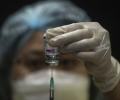
Pune-based Serum Institute of India (SII) is sitting on 200 million doses of Covishield that were manufactured in December and are set to expire in September. The company is likely to destroy these vaccines if nothing works out, Sohini Das reports.

'There will be ups and downs, and we have to plan how we live with it now.'

The Drugs Controller General of India has approved the manufacture of this Sars-CoV-2 spike protein recombinant nano-particle vaccine for 'examination, test, and analysis', reports Sohini Das.
 © 2026 Rediff.com - Investor Information - Advertise with us - Disclaimer - Privacy Policy - Sitemap - Feedback - About us - Terms of use - Grievances